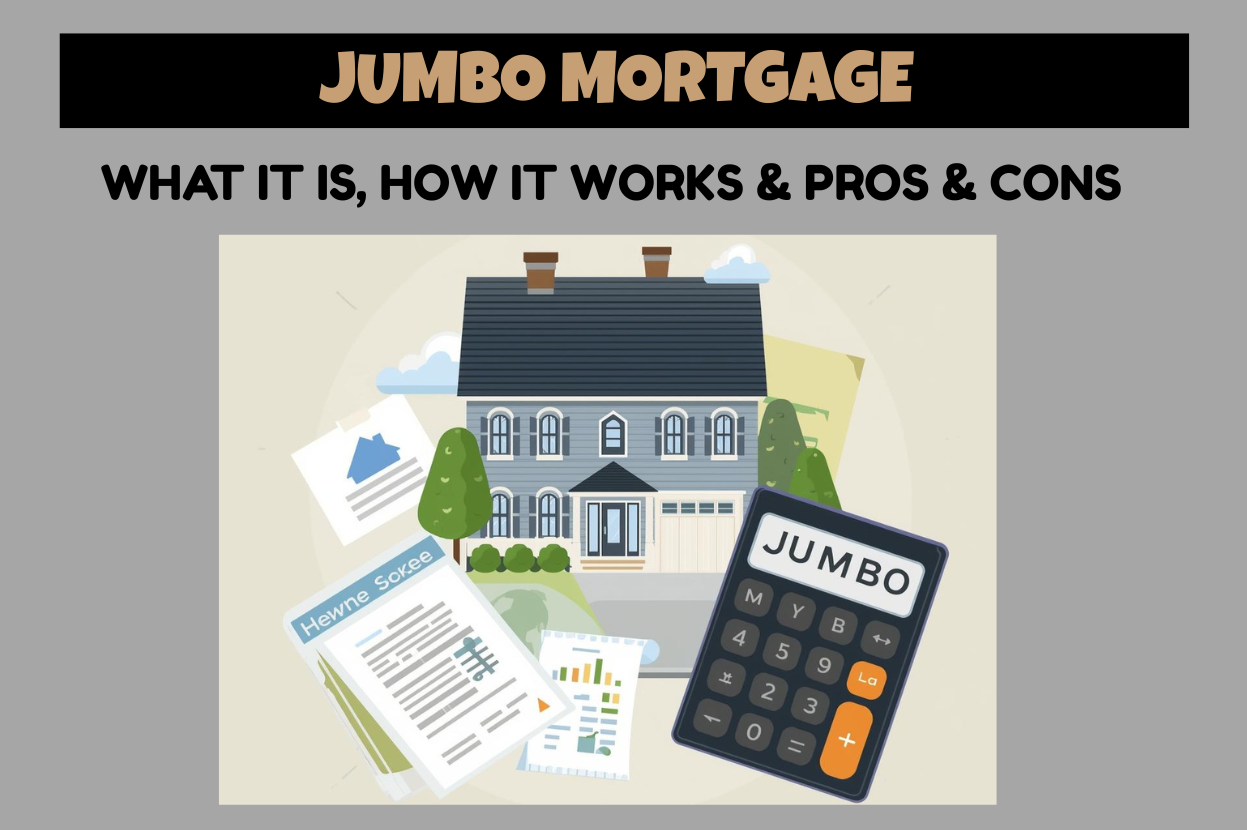
Buying a home has always been one of the biggest financial choices people make. But if you are buying a high-priced or luxury home — especially in cities where real-estate prices keep rising — you might quickly notice that regular mortgages are not enough. This is where a jumbo mortgage (also called a jumbo loan) enters the picture.
A jumbo mortgage helps you borrow more money than what a standard conforming loan allows. These loans make it possible to buy homes that are above the federal loan limits set by the Federal Housing Finance Agency (FHFA).
In simple words, a jumbo mortgage is designed for expensive homes, high-cost housing markets, and situations where you need a loan that goes beyond the “normal” loan size.
In this detailed guide, you’ll learn exactly what a jumbo mortgage is, how it works, who qualifies, what lenders look for, how much you can borrow, and whether it’s the right choice for you.
What Is a Jumbo Mortgage ?
A jumbo mortgage is a non-conforming home loan that exceeds the maximum loan limit allowed for conventional conforming loans. These limits are set by the FHFA, and apply to loans purchased by government-backed agencies like Fannie Mae and Freddie Mac.
For 2025, the general conforming loan limit for a one-unit home in most U.S. areas is $806,500.
Any mortgage above this amount is considered a jumbo loan.
In high-cost areas — such as parts of California, New York, Hawaii, and Washington D.C. — limits can be higher, but jumbo loans usually start once you cross the highest official limit for your location.
Because jumbo mortgages exceed what federal agencies will insure or purchase, lenders take on more risk. That’s why jumbo loans have stricter requirements than standard mortgages.
What is Conventional Mortgage — Pro’s, Con’s, Detailed Guide
How Does a Jumbo Mortgage Work ?
A jumbo mortgage works similarly to any other home loan, but the difference lies in the:
- Loan size
- Qualification standards
- Documentation requirements
- Down payment expectations
- Risk level for lenders
You can choose from:
- Fixed-rate jumbo loans (usually 15 or 30 years)
- Adjustable-rate jumbo loans (ARM) with 5-, 7-, or 10-year fixed periods
- Some lenders offer interest-only jumbo loans, where early payments cover only interest for a limited time
Jumbo mortgages can be used to buy:
- Primary homes
- Second homes
- Vacation homes
- Investment properties (depending on lender policies)
Loan amounts vary by lender. Some lenders approve jumbo loans up to $10 million or more
Why Do Jumbo Mortgages Exist?
In many parts of the United States, home prices have grown far beyond the national conforming loan limits. Without jumbo mortgages, buyers in high-cost areas would not be able to finance homes using standard mortgage products.
Jumbo mortgages solve this issue by offering large-scale financing to qualified borrowers.
Jumbo Mortgage Requirements (What Lenders Look For)
Because lenders cannot sell jumbo loans to Fannie Mae or Freddie Mac, they carry more risk. To protect themselves, they set higher qualification standards.
Here are the main requirements:
1. Strong Credit Score
Most lenders require strong credit because of the larger loan amount. Typical expectations:
- 680 minimum for some jumbo programs
- 700–740+ preferred for most lenders
- Higher scores (760+) may qualify for better interest rates
Credit strength is one of the biggest deciding factors in jumbo mortgage approval.
2. Higher Down Payment
While conforming loans may allow 3–5% down, jumbo mortgages usually require more. Depending on the home price and financial profile:
- 10% down may be allowed for smaller jumbo loans
- 15%–20% down is common
- 30%–40% down may be needed for very large loans or investment properties
PNC, for example, requires around 20% down without secondary financing.
3. Low Debt-to-Income Ratio (DTI)
Lenders need to see that you can comfortably afford the payments.
- Most jumbo lenders prefer DTI below 43%
- Some may allow up to 45% with strong compensating factors
- Lower DTI is always better
4. Proof of Strong Income & Assets
You’ll need to show stable income through:
- Pay stubs
- W-2 forms
- Tax returns
- Bank statements
- Investment accounts
- Business income (if self-employed)
Expect heavier documentation. Jumbo underwriting often requires manual review, not just automated systems.
5. Cash Reserves
Because the loan is large, lenders want to see you have savings left after closing.
For jumbo loans, lenders may require:
- 6 to 18 months of mortgage payments in reserves
- More for high loan amounts or multiple properties
6. Additional Requirements
Depending on the lender, you may need:
- Extra home appraisals
- Asset verification beyond the down payment
- Employment stability checks
- Clean credit history with no major delinquencies
Pros of a Jumbo Mortgage
1. Lets You Buy High-Value Homes
The biggest benefit is the ability to borrow above standard limits, which is essential in high-priced markets.
2. Competitive Interest Rates
While jumbo loans used to have much higher interest rates, the gap has narrowed. Today, jumbo rates can be similar to or sometimes lower than conforming loans, depending on market conditions and borrower strength.
3. Flexible Loan Options
- Fixed or ARM
- Primary or secondary homes
- Investment properties (depending on lender)
This flexibility gives buyers more control.
4. Single Large Loan Instead of Multiple Loans
Instead of using two smaller loans (piggyback structure), a jumbo mortgage gives you one straightforward loan to manage.
Cons of a Jumbo Mortgage
1. Stricter Qualification Rules
You’ll need:
- High credit
- Strong income
- Lower DTI
- Larger down payment
- Significant reserves
Many borrowers may find these rules challenging.
2. Larger Financial Commitment
A larger loan means:
- Bigger monthly payments
- Higher closing costs (often 3%–5% of loan value)
- More interest paid over time
3. Requires More Documentation
Expect deeper financial checks, extra paperwork, and longer underwriting times.
4. Higher Risk for Borrowers
With large loans, even a small change in income or interest rates can affect affordability.
Who Should Consider a Jumbo Mortgage ?
A jumbo mortgage may be right for you if:
- You are buying a home priced above $806,500 (or your local limit)
- You live in a high-cost housing market
- You can afford a 10–20%+ down payment
- You have a strong credit profile
- You want to avoid multiple smaller loans
- You are comfortable with higher monthly payments
- You have substantial savings or financial reserves
People who usually choose jumbo loans include:
- High-income professionals
- Buyers in expensive cities
- Real-estate investors
- Families upgrading to larger properties
- Buyers seeking luxury homes or second homes
Is a Jumbo Mortgage Right for You?
A jumbo mortgage is a powerful tool when used correctly. But like any major financial decision, it works best when it aligns with:
- Your long-term income stability
- Your financial goals
- Your comfort level with larger monthly payments
- Your ability to meet lender requirements
If you have strong finances and are purchasing a high-priced home, a jumbo mortgage can make homeownership possible without needing all the cash upfront.
For others, a conforming loan may be safer and easier to qualify for.
FAQs About Jumbo Mortgages
1. What is the current jumbo loan limit?
For 2025, the base conforming loan limit for a one-unit home is $806,500. Anything above that is considered jumbo.
2. Are jumbo loans harder to qualify for?
Yes. They require stricter credit scores, larger down payments, low DTI, and more documentation.
3. Do jumbo mortgages have higher interest rates?
Not always. Rates may be similar to conventional loans depending on lender competition and borrower profile.
4. Can you get a jumbo loan with 10% down?
Some lenders allow 10% down, but many require 15–20% or more.
5. Can a jumbo mortgage be used for a second home or investment property?
Yes, depending on the lender’s rules. Requirements may be stricter for investment properties.
6. Do jumbo loans require mortgage insurance?
Some jumbo loans do not require PMI even with less than 20% down, but this varies by lender.
7. Are jumbo mortgages risky?
They can be, because of their large size. Borrowers should ensure stable income and emergency savings.
Final Thoughts
A jumbo mortgage can be an excellent option for buyers entering the high-end real-estate market or purchasing homes in expensive locations where standard loan limits fall short. With the right financial foundation — strong credit, steady income, savings, and responsible budgeting — a jumbo mortgage offers flexibility and access to homes that would otherwise be unreachable.
However, because jumbo loans involve more responsibility and larger financial commitments, it’s important to compare lenders, understand all requirements, and choose terms that support long-term financial health.