In today’s digital world, copying something takes seconds.
A photo can be downloaded.
A song can be reposted.
A design can be duplicated and sold in another country overnight.
For creators and businesses, protecting intellectual property (IP) has always been difficult. The legal system was built for paper documents and physical goods. But we now live in a fast, borderless digital economy.
In 2026, blockchain is helping fix many of these long-standing problems.
It is not replacing lawyers or courts.
But it is changing how ownership is proven, how licensing works, and how rights are managed.
Let’s break it down in simple language.
First, What Is Intellectual Property ?
Intellectual property includes:
- Patents – for inventions
- Copyrights – for books, music, videos, and art
- Trademarks – for brand names and logos
- Trade secrets – for confidential business formulas or methods
These are valuable assets. In many companies, IP is worth more than physical property.
The problem?
Proving ownership and enforcing rights has always been slow and expensive.
The Core Problem With Traditional IP Systems
Imagine a photographer uploads an original image to their website. Months later, they find it used in a company’s advertisement without permission.
They know it’s their work. But proving when they created it and that they were first can become a legal battle.
Traditional protection methods include:
- Registering with government offices
- Sending documents to yourself for timestamps
- Notarized paperwork
- Hiring lawyers
These systems are:
- Slow
- Costly
- Limited by country borders
- Hard for small creators to access
In the digital age, infringement spreads faster than courts can react.
This is where blockchain enters.
What Blockchain Actually Does for IP
Blockchain is a digital ledger shared across many computers. Once information is added, it cannot be changed.
For intellectual property, this creates powerful new tools.
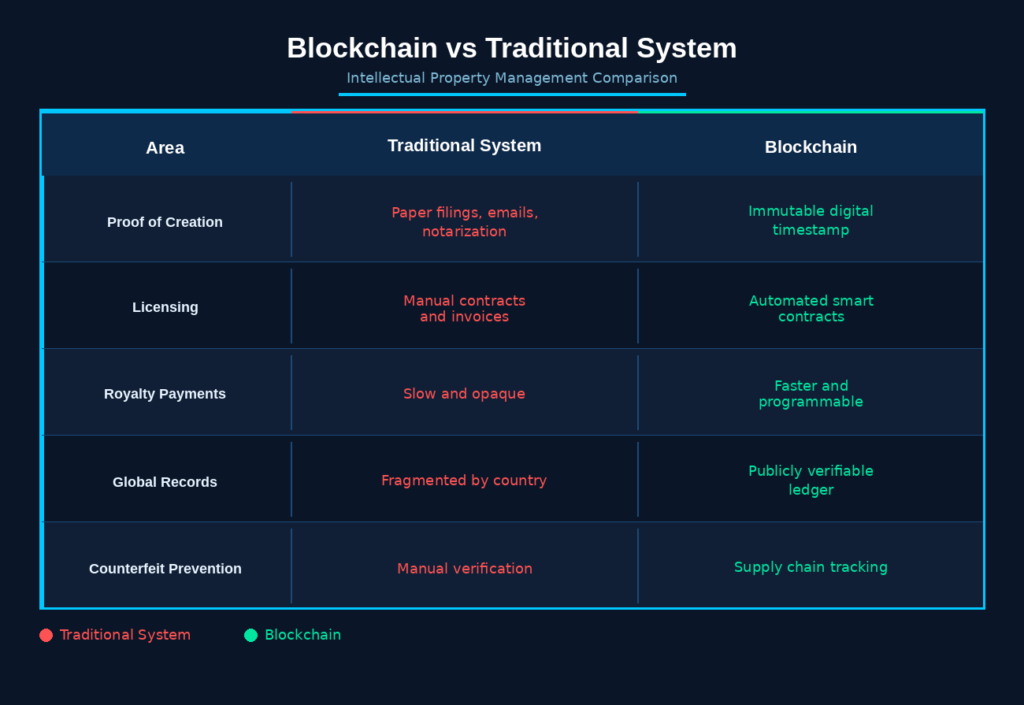
1. Tamper-Proof Timestamping
The most important benefit is proof of existence.
When a creator uploads their work to a blockchain-based platform, the system generates a cryptographic “hash.” This is like a digital fingerprint of the file.
That fingerprint is stored on the blockchain with a timestamp.
If someone later claims ownership, the creator can show:
- The file’s unique fingerprint
- The exact date it was recorded
- A record that cannot be altered
This does not replace copyright law.
But it creates strong supporting evidence.
In some jurisdictions, courts have begun recognizing blockchain records as valid digital evidence. Acceptance is growing worldwide in 2026.
2. Smart Contracts for Licensing
Licensing intellectual property has traditionally required paperwork, negotiation, and manual payments.
Now, smart contracts simplify the process.
A smart contract is code stored on a blockchain that executes automatically when conditions are met.
Example:
A music producer uploads a song and sets a license fee.
When someone pays that fee, the smart contract automatically:
- Grants usage rights
- Transfers payment
- Records the transaction
No chasing invoices.
No confusion about terms.
Everything is recorded transparently.
This is especially useful for:
- Independent musicians
- Digital artists
- Software developers
- Content creators
Royalty payments can also be automated, reducing delays that often frustrate artists.
3. NFTs as Proof of Digital Ownership
Non-fungible tokens (NFTs) gained attention for speculation. But their real value lies in ownership tracking.
An NFT acts as a blockchain-based certificate tied to a digital asset.
When an artwork or design is tokenized:
- Ownership history is visible
- Transfers are recorded
- Secondary sales can trigger automatic royalties
Important:
Owning an NFT does not automatically mean owning the copyright. The legal terms must clearly state what rights are transferred.
Still, NFTs provide strong proof of provenance — showing where an asset originated and how it changed hands.
4. Patent and Trademark Management
Managing patents across countries is complicated.
A patent in one country does not automatically protect you in another. Businesses must file separately in each jurisdiction.
Blockchain-based IP registries are improving transparency and coordination.
For example:
- World Intellectual Property Organization has been researching blockchain applications for IP offices.
- Platforms like IPwe use blockchain to organize patent data and make transactions more efficient.
These systems do not replace official patent offices.
But they make records easier to verify and manage globally.
5. Fighting Counterfeit Products
Blockchain is also helping brands protect physical goods.
Luxury brands, electronics companies, and pharmaceutical firms face massive losses from counterfeit products.
Some companies now assign each product a digital identity recorded on blockchain at manufacturing.
For example, LVMH has tested blockchain systems to verify authenticity of luxury items.
Customers can scan a QR code and verify:
- Where the product was made
- Its supply chain journey
- Whether it is genuine
This builds consumer trust and reduces fraud.
Real-Life Example
Consider a startup developing a new hardware component.
Before filing a patent, they upload their design documentation to a blockchain timestamping platform. This gives them proof of when the idea existed.
Later, they file traditional patents for legal protection.
Meanwhile, they license parts of their technology using smart contracts. Payments are triggered automatically when conditions are met.
They use blockchain not instead of the legal system — but alongside it.
That combination strengthens their protection.
Artificial Intelligence Explained: How It’s Changing Life
What Blockchain Does NOT Fix
It is important to stay realistic.
Blockchain guarantees that recorded data cannot be changed.
But it cannot verify whether the original uploader is the true owner.
If someone registers stolen work on blockchain first, disputes can still happen.
Also:
- Legal recognition varies by country
- Courts still rely on traditional law
- Cross-border disputes remain complex
Blockchain improves evidence and management.
It does not eliminate legal processes.
Key Benefits at a Glance
Who Should Care in 2026?
If you are a:
- Writer
- Photographer
- Musician
- Designer
- Software developer
- Startup founder
- Brand owner
Understanding blockchain IP tools is becoming practical, not optional.
Even small creators can now access affordable timestamping platforms without deep technical knowledge.
Businesses with valuable patents or trademarks should be discussing blockchain-based management tools with their legal teams.
The Bigger Shift
Intellectual property protection used to depend heavily on paperwork, institutions, and slow legal action.
In 2026, protection increasingly starts at the moment of creation.
Ownership can be recorded instantly.
Licenses can execute automatically.
History can be verified globally.
Blockchain is not replacing intellectual property law.
It is modernizing the infrastructure around it.
And for creators in a digital world, that shift is powerful.
Top Cybersecurity Tips to Protect Your Online Identity
Blockchain Beyond Crypto: Real-World Applications You Should Know